Typography and advertising in colonial Korea
The problem
My dissertation takes up two related problems in the material history of colonial Korea, both of which require working across very large collections of digitized print. The two case studies share a common methodological concern: how to move between close viewing and close reading of visual sources without losing sight of either.
Typography & Printshops

The first case study reads the typographic output of four printing houses in colonial Seoul: Sinmungwan, Taedong Inswaeso, Hansŏng Tosŏ, and Chosŏn Inswae. All four bought matrices from the same Japanese foundries and set to the same point sizes, so their pages converge on a narrow shared vocabulary of forms. I treat that convergence as a method rather than an obstacle. Against so uniform a background, the minute ways a shop weights a stroke or finishes a serif become more legible rather than less, the tension the chapter calls the standardisation paradox.
To recover those traces across roughly 57,000 page images, I train a multiple-instance-learning model whose attention scores are the classification itself, so we can identify which patches of a page the model relies on. What surfaces is differentiation through density rather than distinct fingerprints: the four shops share one typographic space, and each concentrates in different parts of it, as in the rendering of the iŭng (ㅇ) or the heavy initial serifs that mark Hansŏng Tosŏ. These signatures track the printer that set the page, not the publisher that commissioned it.
Advertising & Consumer Culture
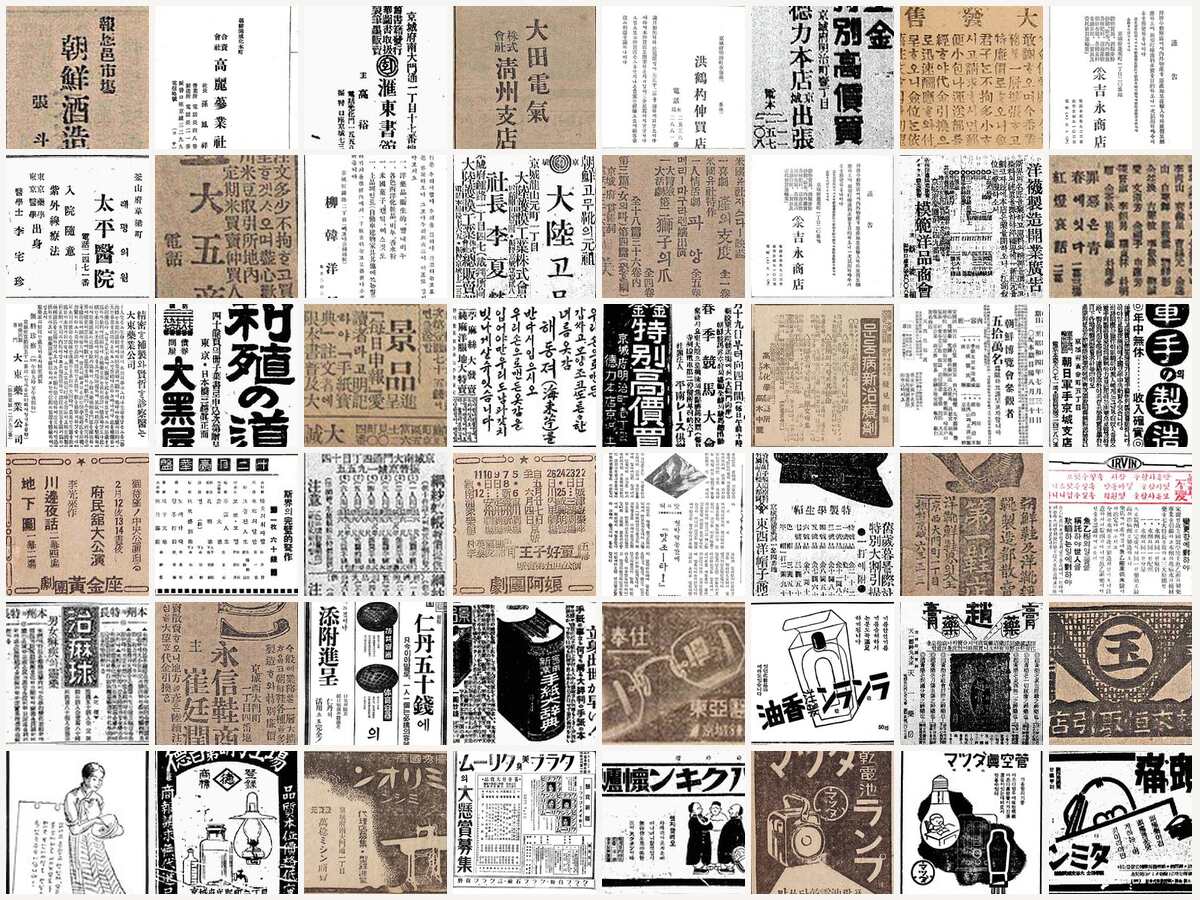
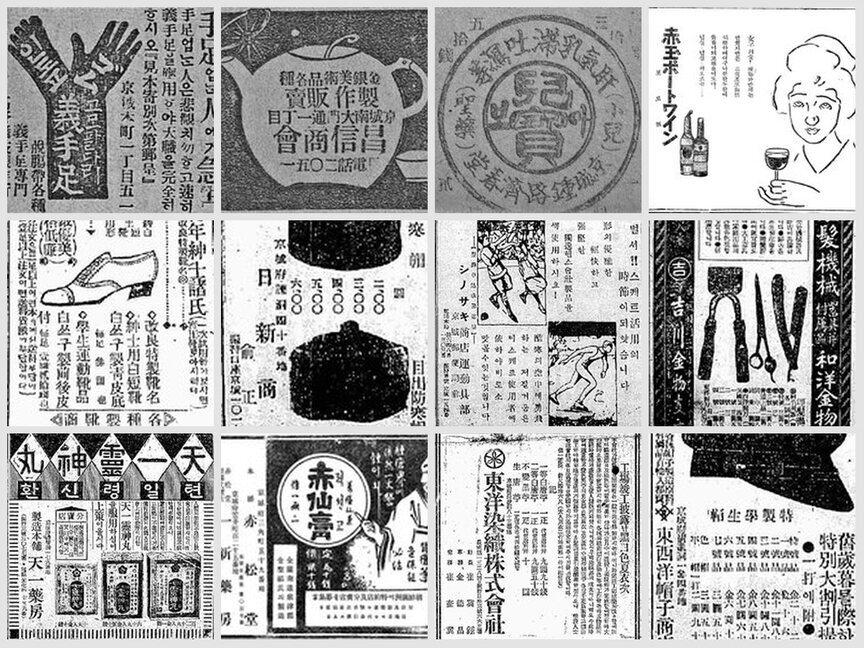
The second case study examines the rise of mass advertising in colonial-era newspapers as both a visual and a social phenomenon. Using computer vision, I segment and extract hundreds of thousands of advertisements from newspaper page images. Large language models then classify and annotate them with structured metadata, which makes it possible to treat advertising as quantifiable historical evidence.
The dataset is the point: it lets questions about consumer culture, visual persuasion, and commercial networks be posed across an entire corpus rather than through scattered examples alone.